What Is Pragma?
Pragma is a verified civic participation platform — web and mobile — where real, authenticated citizens submit community problems, co-author formal policy briefs, and have those briefs delivered directly to their elected representatives with a full digital paper trail.
Every member verifies their legal identity to join, eliminating bots and fake accounts entirely. An AI layer fact-checks claims and translates legal jargon into plain English. The politician's response — or silence — is posted publicly for the entire district to see on a live accountability dashboard.
The UVP:> "We believe the people closest to the problem are closest to the solution — and for too long, those people have been the ones who sent the email and got nothing back. Who signed the petition and watched it disappear. Who showed up to the town hall and left feeling smaller than when they walked in. Pragma gives every verified citizen — not lobbyists, not donors, not the powerful — a direct, documented, and permanent seat at the table where decisions about their lives are made. Your silence is over. Their excuses are too."
The Problem We're Solving
The civic engagement pipeline is broken at every step:
No platform currently combines legal identity verification, AI-assisted policy drafting, verified delivery to lawmakers, and public accountability tracking in a single product. Pragma does all four.
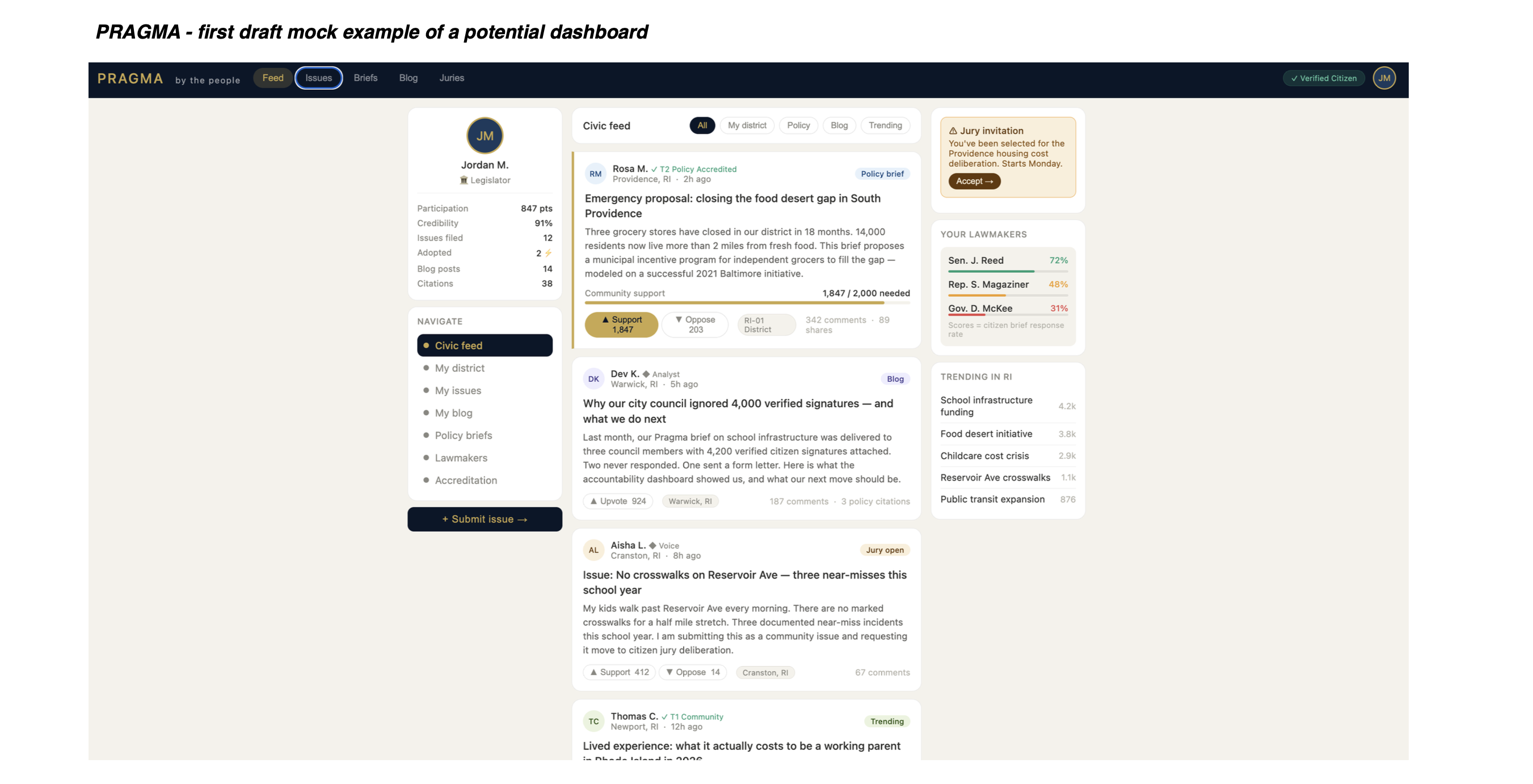
Platform Dashboard
How It Works
01 — Citizen submits a real, verified community problem 02 — Community deliberates and refines the solution 03 — AI fact-checks claims and translates legal language 04 — Formal policy brief delivered to the lawmaker 05 — Response rate published publicly for the entire districtBusiness Model
Pragma operates on a freemium + B2G (Business-to-Government) revenue model:
Customer Discovery
Conducted 6 in-depth customer interviews validating the core concept. Key findings:
Customer Segments
Segment 01 — The Civically Frustrated Action Taker (Ages 25–45)
Educated, employed citizens who already try to engage with government — write emails, attend meetings, sign petitions — but keep hitting walls. They haven't given up yet, but they're close. College-educated, politically active online, community-involved. Pragma gives them what they've been looking for.
Segment 02 — The Municipal Government Decision Maker (Ages 38–58)
City managers, directors of community engagement, and chiefs of staff who need to demonstrate constituent responsiveness. They waste budget on empty town halls. Pragma replaces that with something verified, scalable, and measurable.
Deliberately Avoided — The Vocal Non-Actor
Politically loud online but never follows through. High complaint volume, zero constructive contribution. Not the user Pragma is built for.
The Ad Campaign
Developed an industry-standard multi-channel ad campaign targeting both customer segments simultaneously.
LinkedIn B2G Campaign — Sandra W. Persona
Channel: LinkedIn feed carousel (1200×628) + Direct InMail to city managers Budget: $400/month | Duration: 45 days Emotional trigger: Status + Professional Fear + Social ProofSandra W. (Director of Community Engagement) does not respond to emotional appeals — she responds to professional risk and peer authority. The trigger: *"Your peer city managers are already exploring this. What does it say about you if you're the last to know?"*
Targeting: Job titles — City Manager, Director of Community Engagement, Chief of Staff. Industry: Government Administration. Geography: Rhode Island + New England metros. CTA: *"Request a free 90-day pilot — no procurement commitment required."*The free pilot removes the single biggest procurement barrier. The specific language *"no procurement commitment required"* gets past risk-aversion and removes the internal approval barrier entirely.
Industry reference: Mirrored the professional tone of Salesforce Government Cloud LinkedIn campaigns — peer social proof, ROI comparison language, case study format. Zero consumer emotional language.